
Jupiter's Great Red Spot

Jupiter has a spot that will not go away. The Great Red Spot is not a mark on the planet’s surface, because Jupiter does not have a solid surface like Earth. It is actually a gigantic storm swirling around in Jupiter’s atmosphere.
This storm is so large that Earth could fit inside it, although it used to be even bigger. Astronomers have watched the Great Red Spot for many years, and spacecraft visiting Jupiter have helped reveal it as one of the most famous storms in the Solar System.
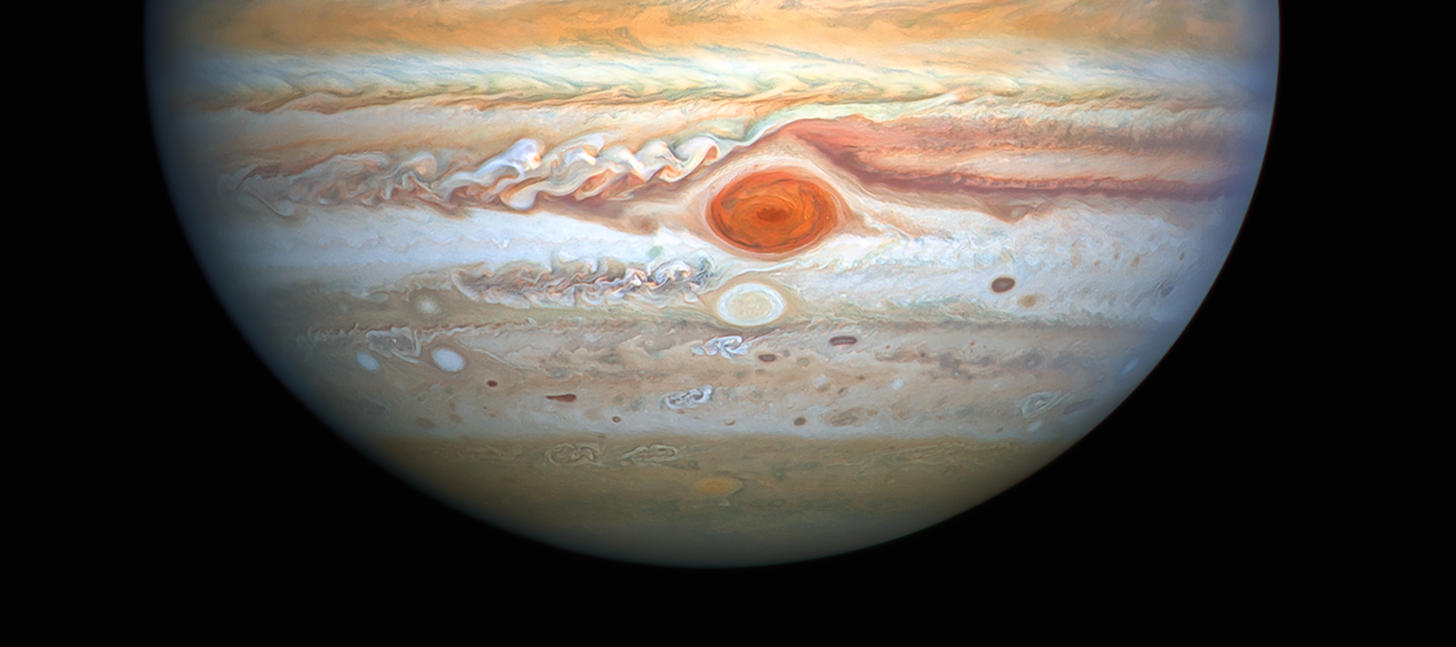
Jupiter's Great Red Spot - At a Glance
- The Great Red Spot is a huge storm in Jupiter’s atmosphere.
- It is an anticyclone, which means it is a high-pressure storm system.
- The storm is large enough to swallow Earth.
- It has been observed for at least 150 years, and possibly much longer.
- The Great Red Spot has been shrinking over time.
- Scientists are still not completely sure what gives it its reddish colour.
The Great Red Spot is a huge storm in Jupiter’s atmosphere. It is known as an anticyclone, which means it is a high-pressure storm system. On Earth, storms usually weaken when they move over land or run out of energy. Jupiter is different because it has no solid surface for the storm to crash into.
Jupiter’s atmosphere is full of powerful winds moving in different directions. The Great Red Spot sits between these fast-moving bands of air, which help keep it spinning. Instead of being a short-lived storm like a hurricane on Earth, it has continued for generations.
How Big is the Great Red Spot?
The Great Red Spot is enormous. It is large enough for Earth to fit inside it. Whether it would want to fit inside it is another matter.
However, the storm used to be much larger. In the late 1800s, observations suggested that it was wide enough to fit about three Earths across it. By the time the Voyager spacecraft flew past Jupiter in 1979, it had become smaller, and later observations by the Hubble Space Telescope showed that it was continuing to shrink.
Even though it is smaller than it used to be, it is still one of the largest and most recognisable storms in the Solar System.
How long has it been there?
Astronomers have observed the Great Red Spot regularly since the 1800s. The German astronomer Samuel Heinrich Schwabe is usually credited with making the first confirmed observation of the current Great Red Spot in 1831.
However, Jupiter had been showing off spots long before then. In 1664, Robert Hooke recorded a spot on Jupiter, and in 1665 Giovanni Cassini described a feature that became known as Jupiter’s “Permanent Spot”. Cassini’s spot was seen several times until the early 1700s.
The problem is that nobody knows for certain whether those earlier spots were the same storm seen today. There was a long gap in observations, so Cassini’s “Permanent Spot” may have faded away, disappeared, or been replaced by a new storm in a similar part of Jupiter’s atmosphere.
The Great Red Spot is famous for its reddish-orange colour, but scientists are still not completely sure what causes it. The colour may come from chemicals in Jupiter’s atmosphere being changed by sunlight.
The spot does not always look the same. Sometimes it appears darker and redder, while at other times it becomes paler. This tells scientists that the storm is not frozen in time. It is constantly changing, even if it looks familiar from a distance.
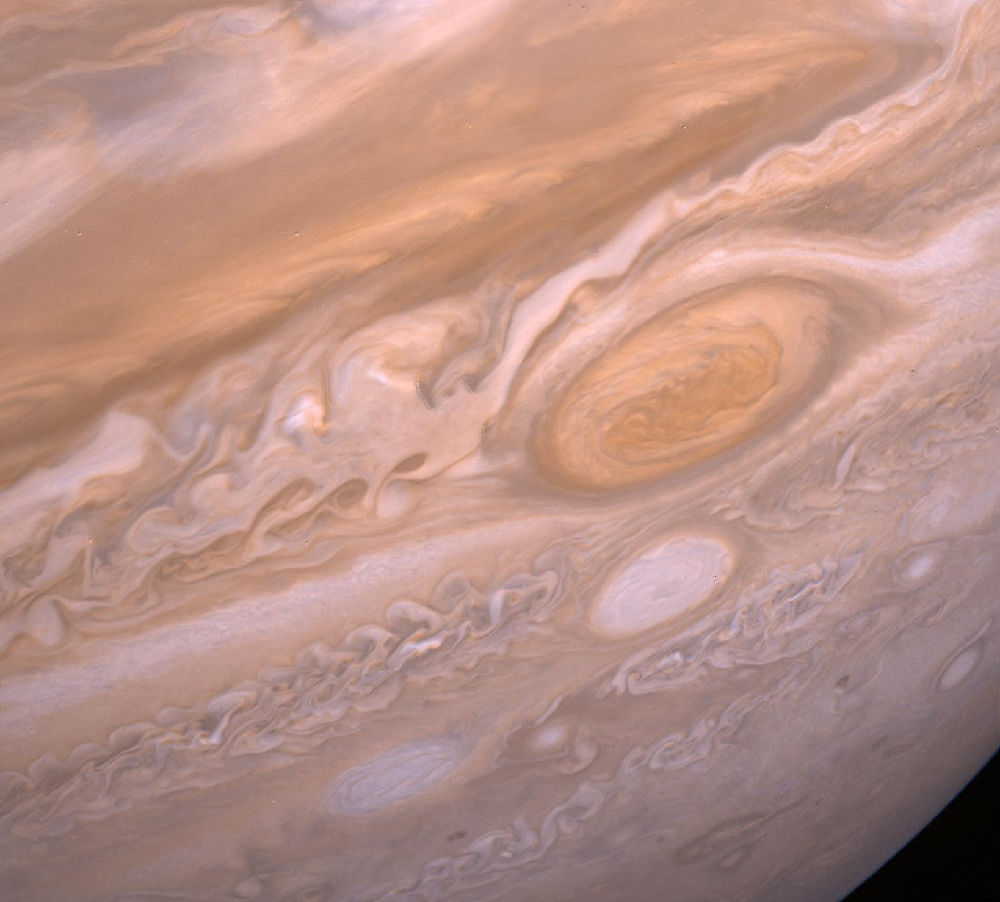
Is the Great Red Spot disappearing?
The Great Red Spot has been shrinking for a long time. Modern observations show that it is much smaller than it was in the past, and scientists continue to watch how it changes.
This does not necessarily mean that the storm is about to vanish. Jupiter’s atmosphere is complicated, and the visible red oval may change shape and size while the deeper storm continues below. For now, the Great Red Spot is still there, still spinning, and still giving Jupiter its most famous feature.
Explore this section ↑