
Fifteen Facts about Jupiter

Jupiter is the largest planet in the Solar System, a huge world of storms, clouds, moons, stripes, plus a rather large spot. Here are fifteen facts about the king of the planets.
Jupiter is the fifth planet from the Sun
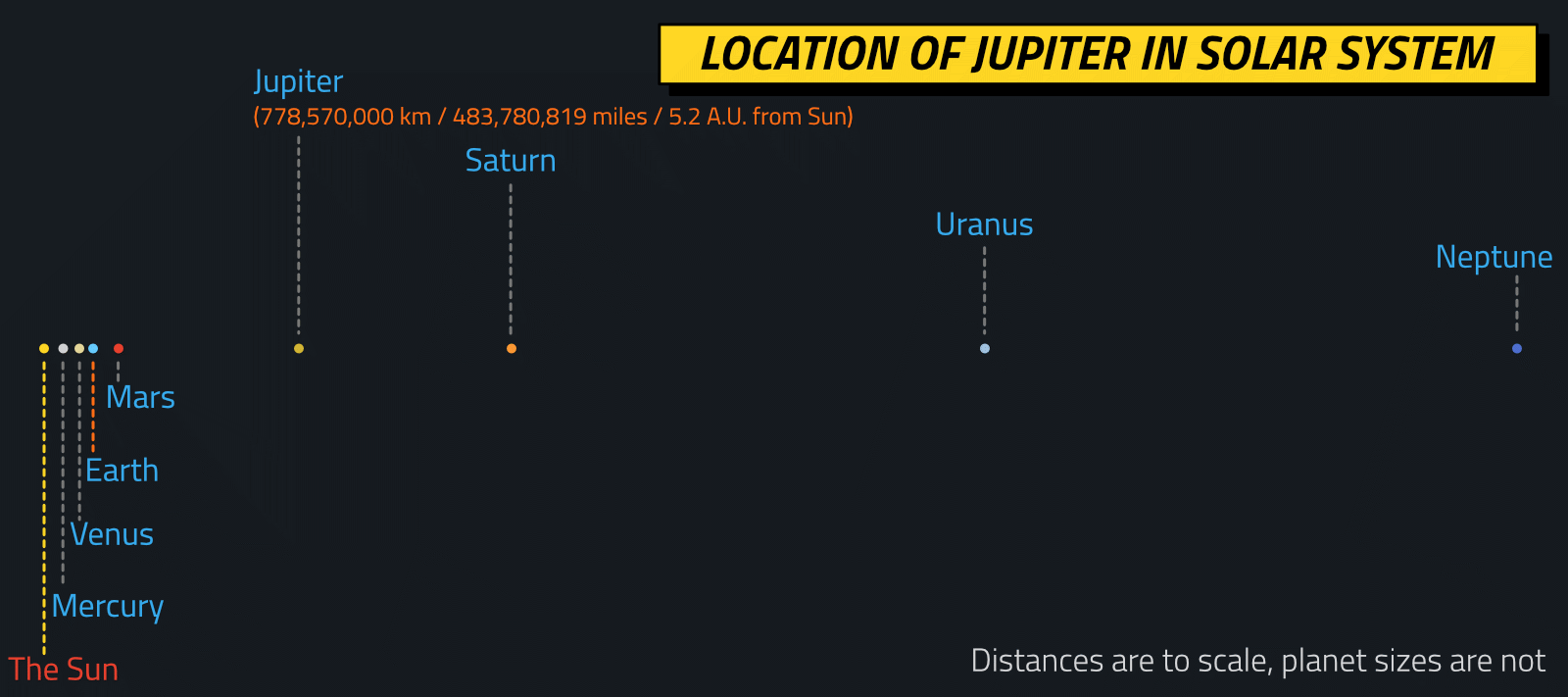
Jupiter orbits the Sun at an average distance of about 778 million kilometres, or 484 million miles. This places it beyond Mars and the asteroid belt, making it the first of the giant planets, also known as the outer planets. It is much farther from the Sun than Earth is, so one year on Jupiter lasts almost 12 Earth years. That’s a long time to wait for a birthday.
Jupiter is the largest planet in the Solar System
Jupiter is enormous. It has a diameter of about 139,820 kilometres, or 86,881 miles, making it more than 11 times wider than Earth. If Jupiter were a hollow shell, more than 1,000 Earths could fit inside it. Or, if you don't have 1,000 Earths, you could fit one of each of all of the Solar System's planets in it. Well, all of them except Jupiter. You couldn't put Jupiter inside of Jupiter. That's just crazy talk.
Jupiter is a gas giant
Jupiter is known as a gas giant because it is made mostly of hydrogen and helium, the same main ingredients as the Sun. It does not have a solid surface like Earth, Mars or Mercury. If you tried to land on Jupiter, you would sink down through thicker and thicker clouds, gas and slushy material until the pressure crushed your spacecraft into an expensive pancake. We don't recommend doing this.
Jupiter has the shortest day of any planet
Although Jupiter is the biggest planet, it spins incredibly quickly. One full rotation takes only about 9.9 hours, giving Jupiter the shortest day of any planet in the Solar System. This fast spin helps stretch its clouds into the striped belts and zones we see through telescopes and spacecraft images. It also squashes the planet, so it is wider than it is tall as its sides bulge out as it spins.
Jupiter has stripes made from clouds
Jupiter’s famous bands are made from cold, windy clouds of ammonia and water floating in an atmosphere of hydrogen and helium. The darker stripes are called belts, while the lighter stripes are called zones. These bands move in different directions, creating a giant, swirling, stripy atmosphere.
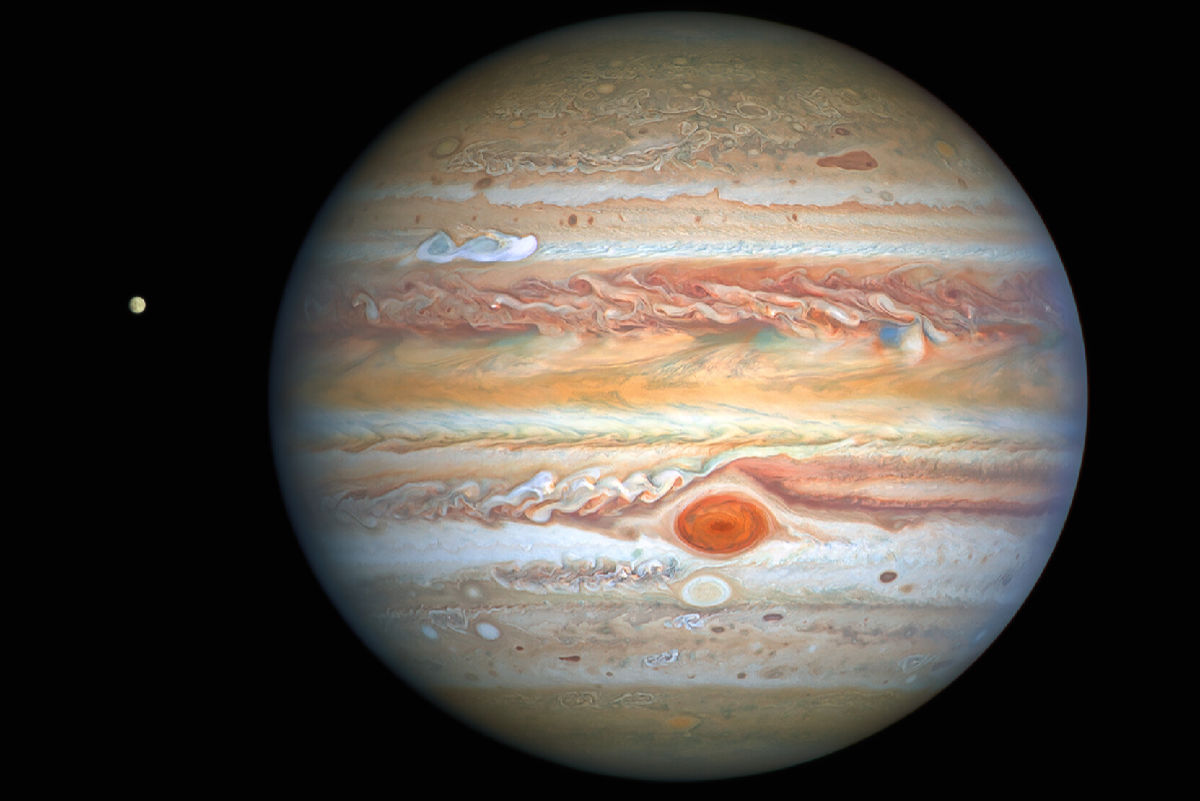
Jupiter has a centuries-old mega-storm bigger than Earth
The Great Red Spot is a gigantic storm in Jupiter’s atmosphere. It is larger than Earth and has been raging for hundreds of years. Scientists have noticed that it has been shrinking over time, but it is still one of the most famous features in the Solar System.
Jupiter has more than 100 moons
Jupiter has 101 officially recognised moons as of March 2026. The four largest are Io, Europa, Ganymede and Callisto. They are known as the Galilean moons because Galileo Galilei observed them in 1610. This was a huge discovery because it showed that not everything in space orbited Earth. Religious leaders at the time didn't want to accept this, so placed him under house arrest for the rest of his life.
Ganymede is the largest moon in the Solar System
Ganymede, Jupiter’s largest moon, is bigger than the planet Mercury. It is also the only moon known to have its own magnetic field. If Ganymede orbited the Sun directly instead of Jupiter, people would probably call it a planet. Instead, it has to live with being just the largest moon in the Solar System. Poor enormous thing.
Europa may have an ocean beneath its ice
Europa is one of the most exciting moons in the Solar System. Beneath its icy surface, scientists think there is a deep global ocean of liquid water. Because water is one of the key ingredients for life, Europa is one of the best places to search for possible life beyond Earth. NASA’s Europa Clipper mission is travelling to Jupiter and is expected to arrive in April 2030 to study whether Europa could support life.
Io is the most volcanically active world in the Solar System
Io, another of Jupiter’s big moons, is covered in volcanoes. Its eruptions are powered by tidal forces from Jupiter and the other large moons, which stretch and squeeze Io as it orbits. This keeps its interior hot and active, which belches its way to the surface almost constantly. It kind of looks a bit like a pizza.
Jupiter has rings
Saturn gets all the attention for its rings, swanning around like the jewellery counter of the Solar System, but Jupiter has rings too. They are faint, dark and made mostly of tiny dust particles. They are much harder to see than Saturn’s rings, so Jupiter doesn't like to make too much of a fuss about them.
Jupiter has a powerful magnetic field
Jupiter has the strongest magnetic field of any planet in the Solar System. It creates enormous auroras near the planet’s poles and traps dangerous radiation around the planet. If it was possible to see Jupiter's radiation belt, the planet would appear as large as the Sun from Earth.
Jupiter may have helped shape the Solar System
Because Jupiter is so massive, its gravity has had a huge influence on the Solar System. It can fling comets and asteroids into new paths, sometimes sending them away from the inner Solar System and sometimes sending them inward. Jupiter is often described as the bodyguard of the Solar System with its ability to deflect or absorb objects that travel through the Solar System. The Comet Shoemaker-Levy 9 was witnessed colliding with Jupiter in 1994.
Several spacecraft have visited Jupiter
Jupiter has been visited by several spacecraft, including Pioneer 10 and 11, Voyager 1 and 2, Galileo, Cassini, New Horizons and Juno. NASA’s Juno spacecraft has been orbiting Jupiter since 2016, studying its clouds, gravity, magnetic field and interior. Jupiter is a difficult place to visit, but apparently spacecraft keep deciding it’s worth the trip.