
Fifteen Facts about Saturn

Saturn is the sixth planet from the Sun and probably the most glamorous planet in the Solar System. With its enormous glistening rings of ice, and a huge family of moons, Saturn is probably the most photogenic of the planets. Here are fifteen facts about Saturn, the Lord of the Rings. The space one, not the hobbit one.
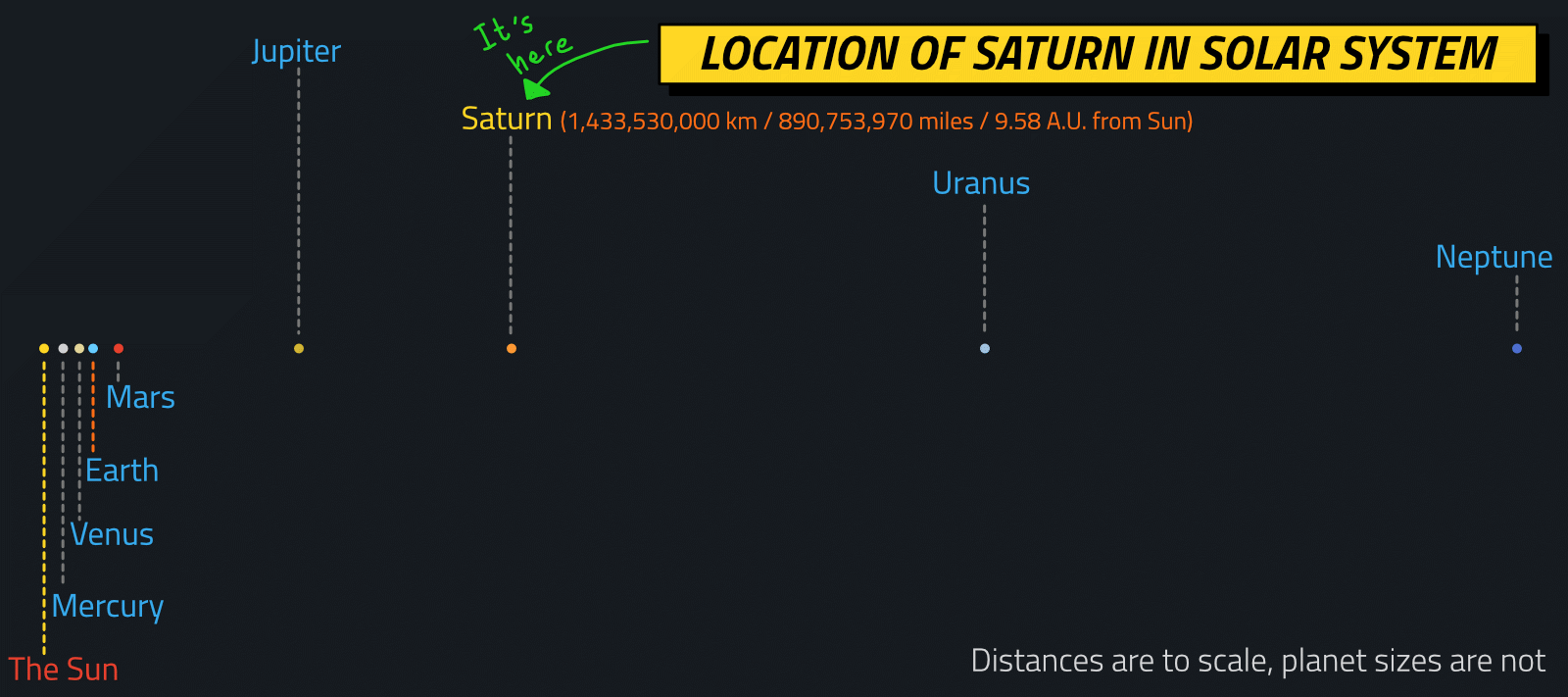
Saturn is the sixth planet from the Sun
Saturn orbits the Sun at an average distance of about 1.4 billion kilometres, or 886 million miles. This makes it nearly twice as far from the Sun as Jupiter. A year on Saturn lasts about 29.5 Earth years, so if you were born there, you would have to wait a very long time for birthday cake.
Saturn is the second largest planet in the Solar System
Saturn is the second largest planet, after Jupiter. It has a diameter of about 116,460 kilometres, or 72,367 miles. That makes it more than nine times wider than Earth. It is smaller than Jupiter, but still absolutely enormous by normal planet standards.
Saturn is a gas giant
Like Jupiter, Saturn is made mostly of hydrogen and helium. It does not have a solid surface that you could stand on. Beneath its clouds, the pressure and temperature increase until the gas becomes almost like a slush, mixed in with heavier elements like metals and rocks at the core.
Saturn is famous for its rings
Saturn is not the only planet in the Solar System with rings, but its rings are by far the most spectacular. They stretch hundreds of thousands of kilometres from the planet, but are surprisingly thin compared with their width. They are made mostly of pieces of ice, with some rock and dust mixed in.
Saturn’s rings are split into many sections
Saturn’s rings are not one solid sheet. They are divided into many separate rings and gaps. Some gaps are caused by the gravity of Saturn’s moons, which tug ring particles into particular paths. The most famous gap is the Cassini Division, a dark-looking region between the A ring and B ring.
Saturn is the least dense planet
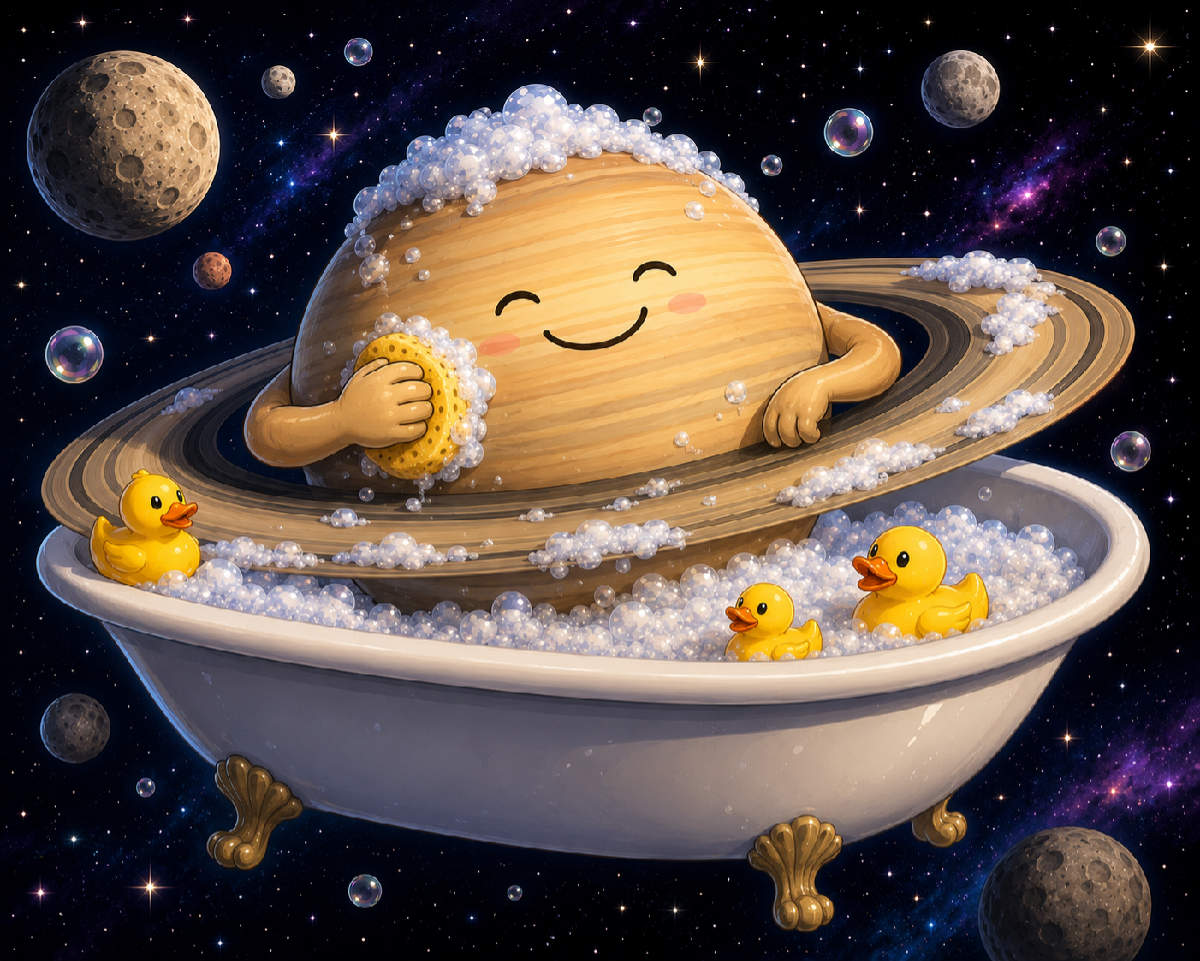
Saturn is huge, but it is also surprisingly light for its size. Its average density is lower than water. This has led to the famous fact that Saturn would float in a giant bathtub.
Saturn has hundreds of moons
Saturn has more known moons than any other planet. NASA currently lists 274 confirmed moons, while more recent IAU/MPC announcements in April 2026 brought the widely reported count to at least 292. Many of these are tiny, distant objects, likely to be rocks captured by Saturn's gravity, or fragments from collisions of other rocks. The number is likely to keep increasing.
Titan is Saturn’s largest moon
Titan is Saturn’s largest moon and the second largest moon in the Solar System. It is bigger than Mercury and has a thick atmosphere, mostly made of nitrogen. Titan is one of the most fascinating places in the Solar System because it has weather, clouds, rivers, lakes and seas. The catch is that these are not made of water, but liquid methane and ethane. In 2005, the Huygens probe landed on Titan and took photographs from its surface, and is so far the only spacecraft to send back pictures from the surface of a moon (other than Earth's moon). It also recorded sounds from Titan during its descent.
Titan has lakes and seas, but not of water
Titan is the only moon known to have stable liquid on its surface. Its lakes and seas are made of liquid hydrocarbons such as methane and ethane. Water on Titan is frozen solid like rock because the moon is so cold.
NASA is sending a flying robot to Titan
NASA’s Dragonfly mission is planned to explore Titan using a rotorcraft lander, a flying vehicle that will move from place to place through Titan’s thick atmosphere. It is expected to launch in 2028 and arrive at Titan in 2034. The mission will investigate Titan’s chemistry and whether its environment could teach us more about the ingredients needed for life.
Enceladus sprays water into space
Enceladus is one of Saturn’s most exciting moons. It has jets that spray water vapour and icy particles from cracks near its south pole. These jets suggest that Enceladus has a salty ocean beneath its icy crust. That makes it one of the best places in the Solar System to investigate whether habitable environments exist beyond Earth.
Saturn has powerful storms
Saturn may look calm and elegant, but its atmosphere is full of powerful winds and storms. Huge storms sometimes appear as bright white patches and can spread around the planet. Saturn also has a strange hexagon-shaped jet stream at its north pole. Yes, a hexagon.
Saturn gives off more heat than it receives from the Sun
Saturn radiates more energy into space than it receives from the Sun. Much of this extra heat is thought to come from the slow settling of helium deeper inside the planet, releasing energy as it falls.
Cassini studied Saturn for 13 years
NASA’s Cassini spacecraft arrived at Saturn in 2004 and studied the planet, rings and moons until 2017. It revealed enormous amounts about Saturn’s rings, Titan’s lakes, Enceladus’s geysers and the whole Saturn system. At the end of its mission, Cassini was deliberately sent into Saturn’s atmosphere to avoid contaminating moons that might have environments suitable for life.
Saturn may lose its rings one day
Saturn’s rings may look permanent, but they are not expected to last forever. Ring particles are gradually falling into Saturn in a process sometimes called ring rain. Over very long timescales, the rings may fade away. So if you want to admire Saturn at its best, now is a good time. You know, astronomically speaking. They'll be there for a few more million years.