
Cordelia, a moon of Uranus
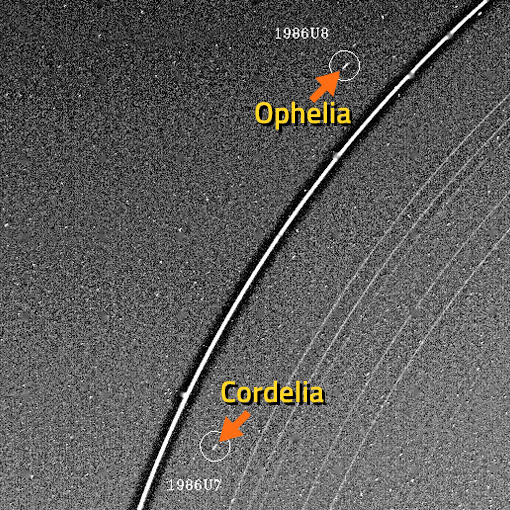
Voyager 2's discovery image of the moons Cordelia (1986U7) and Ophelia (1986U8) from 21st January 1986. Image credit: NASA/JPL
30,944 miles
25 miles
Cordelia and Ophelia are referred to as shepherd moons. Shepherd moons are moons that exist on either side of a planet's ring, holding the materials of that ring in place and preventing them from escaping.
Cordelia and Ophelia are shepherd moons of Uranus' brightest ring, known as its ε ring or Epsilon ring. Cordelia orbits on the inner side of the ring while Ophelia orbits on its outer side.
In William Shakespeare's play King Lear (tragedy, 1605), Cordelia is the youngest and favourite of the King's three daughters. King Lear intends to give his daughters a share of his Kingdom in return for public declarations of their love for him. He believes that Cordelia loves him the most, so reserves the largest part for her. Cordelia's sisters, Regan and Goneril, are only too happy to express their love for their father, although their words are largely false as their true intention is to secure their share of the Kingdom. Cordelia finds it hard to put into words her love for her father, and doesn't really think that she should need to. She says nothing, King Lear gets angry and banishes her from the Kingdom. Cordelia escapes to France, where she marries the French King. Regan and Goneril turn against their father in an attempt to seize control of his Kingdom. King Lear escapes into the wilderness, descends into madness, decides to blind himself, and is later imprisoned by Goneril. Cordelia returns from France in an attempt to rescue her father. They briefly reconcile, but Cordelia is captured and sentenced to death. Holding his daughter's lifeless body, King Lear then also dies.
All moons of Uranus are named after characters in plays by William Shakepeare or a poem by Alexander Pope. Cordelia is the only moon of Uranus to be named after a character in the play King Lear.